delete

Bobby_fischer

Bobby Fischer  was aged six in 1949 when he and his sister Joan bought  a chess set from the candy store beneath their Brooklyn apartment. They taught themselves to play from the instructions on the box. From that day the game defined his life.

Soon after learning the game, he found a book of old chess games and studied it intensely. His sister must have become sick of being beaten, as the following year his mother asked the local paper to find other boys of his age (7!) who might be interested in playing. Instead, the paper referred him to a visiting chess master who was playing an exhibition of simultaneous games. Bobby, still 7, played him and lost – but his play brought him to the attention of the president of the local chess club, and he subsequently was mentored by a number of Manhattans finest masters.

He was a prodigy. At the age of 13 he played a ‘brilliancy’ against DonaldcByrne which is still referred to as ‘the game of the century’. 

He won the first of eight consecutive US championships the following year – aged 14. He became a grandmaster at age 15, and in 1963 won the US championships 11-0, which remains the only perfect score in the history of the championships.

Fischer dropped out  of Erasmus Hall High School as soon as he legally could at age 16. His classmates had included Barbra Streisand and Neil Diamond. That same year his mother moved out of their apartment to pursue a career in medicine, leaving him to his own devices. Still aged 16, he published his first book ‘Bobby Fischer’s Games of Chess.’

Fischer had not competed or had withdrawn from the World Championships in the 1960’s, but became determined to win the 1970 – 1972 round  (World Championships being held over a three year period.)  It was the height of the Cold War, and chess was dominated by Russian grandmasters.  Fischer systematically began to beat them all, and gained the world number one ranking in 1971. However,  he had not yet beaten the reigning champion, Russia’s Boris Spassky. His chance came in the finals of the World Championships in 1972.

Appropriately an exotic venue was chosen for this cold war battle. The most anticipated chess match of all time took place in Reykjavík, in Iceland, from July to September 1972. Fischer had a lifelong stubbornness about playing conditions for tournaments – and he refused to play at all until the prize money was fixed at an unprecedented $250,000.

The championship match was decided over 21 games. Fisher lost the first when he tried a surprising pawn sacrifice in the end game – and he forfeited the second as he was annoyed by the cameras. Spassky agreed to play the third game in a private back room, and the subsequent games returned to the main stage.

Of the final 19 games, Fischer won nine, drew ten, and lost only 1. Therefore, he won the championship 12 and half to 8 and a half. He was an instant celebrity, and at age 29 returned home to a hero’s welcome. He appeared on the cover of Sports Illustrated.

He never defended his title, and in fact never played a proper chess tournament again. It was 20 years before he played in public for one last time.

Fischer was an eccentric even by the standards of the eccentric world of chess. His life became increasingly shambolic. In 1992 he played in an unofficial rematch against Spassky in Yugoslavia against UN sanctions.(he won this rematch), He was unable to return to the USA. He lived in Hungary, Germany, the Philipines, and spent some years in jail in detention in Japan before being taken in by Iceland, who made him a citizen to obtain his release. He died there in January 2008. He had been undefeated in a Chess match from the age of 23.

The brilliant 23 year old Anatoly Karpov placed Fischer as World Chess Champion when he refused to defend his title in 1975, and Garry Kasparov eventually replaced Karpov as World Chess Champion in 1985. Kasparov had been brought up on Fishers ’60 Memorable Games’. Although he never played him, the question of ‘How would you have gone against Bobby Fischer’ was the dominant question he faced throughout his career.  Kasparov wrote that Fischer “became the detonator of an avalanche of new chess ideas, a revolutionary whose revolution is still in progress.” Experts say that Kasparov is the only person who might rival Fischer as the greatest chess player ever.

In the latest NY times Review of Books, Kasparov tells the Shakesperean story of Bobby Fischer’s life in a fascinating personal review of a new biography of the American grandmaster.

Thanks to Mike for the tip about the article.


What I Learnt On 19th February in other years

19th February 2014 Now, that’s a hotel
Add a comment
delete

Nudge

Nudge – Thaler and Sunstein

You can still help people achieve better outcomes – while absolutely respecting freedom of choice.

When a decision is to be made, most people take the path of least resistance – which is often ‘no decision’.

Good ‘choice architecture’ makes it easier for people to end up with the best solution for them.

How good are we at giving a ‘nudge’? Professors Thaler and Sunstein outline their philosophy of “libertarian paternalism’ with many practical examples.

The authors have also established a companion blog at http://nudges.org

Booko Link

Kindle Link 


What I Learnt On 18th February in other years

Add a comment
delete

Super 15 Rugby kicks off tomorrow (Friday). SANZAR has adopted a new format with more local derbies.

The first game for the NSW Waratahs is against the new Melbourne Rebels team – kick off 7:40pm Friday Feb 18th (in Melbourne). Go the Waratahs,

There is still time to enter in a footy tipping comp, as our extended family does each year. There is now a footytips iPhone app to make entering your tips easier.footytips 

In this Rugby World Cup year, the All Blacks have been in secret high-performance training camps over summer.

This video obtained by WikiLeaks gives us an indication of what they have been doing.

The Australian teams have clearly adopted the same tactic that has paid dividends in previous world cup preparations – lull the kiwis into a false true sense of complacency.

Sad, very sad.


What I Learnt On 17th February in other years

Add a comment
delete

Arthur C Clarke (1917-2008) is the doyen of science fiction writing. He published hundreds of short stories and many award winning novels. He is perhaps most famous for the the movie 2001: A Space Odyssey, which he co-wrote with the director,Stanley Kubrick.

He started out as a radar technician in the army, and is credited with being the first to outline the idea that bouncing signals of geostationary satellites would be an ideal way to relay telecommunications.

Among his many short stories, this 31 word piece ‘siseneG is his shortest.

As he says in his letter to the publisher, ‘I think you’ll agree that they don’t come much shorter’.

Siseneg

via (the very excellent site) Letters of Note

What I Learnt On 16th February in other years

Add a comment
delete

Anchovies

Why so wet?

Counterpoint aired an interview with hydro-climatologist Prof Stewart Franks this week and asked him to explain why it has been so wet.

It appears it is all to do with ENSO*, and once again proves the interconnectedness of all things.

In some years, around Xmas time, the fisherman in Peru have a bumper catch of anchovies.’Ole!’ they say as they feast, ‘Praise to El Nino – the Christ Child (literally ‘the boy’). Pass the patatas bravas, will you?’

Normally, the current along the South American coast Is from South to North, bringing cold water to the equatorial regions. This is known as La Nina – the girl. As a consequence, the ocean temperature is normally 8 degrees colder in the Eastern Pacific (South America) than it is in the Central (Tahiti) or Western Pacific (Austalia).

Sometimes, this cold current slows or ceases, and the water around Peru warms so that it is similar to the temperature in Tahiti. Hooray, more anchovies. This phenomenon (loss of the normal cold current) is the celebrated ‘El Nino’.

Whether El Nino will occur depends on lots of things that we can’t calculate, but by May each year the die is cast, and we can predict whether El Nino or La Nina will arrive at Christmas time.

Meanwhile……The climate in South East Queensland and Northern NSW (known as the ‘Greater Alstonville Area’) is characterized by summer rain.

During La Nina, the water near Tahiti is much warmer than Peru, the air pressure in Tahiti is high, and the breezes blow across the sea towards Australia, picking up moisture as they cross the ocean. Greater Alstonville is at risk of flooding rains – but generally the increased rainfall makes farmers and frogs much happier. (our Peruvian friends will have to choose a different tapas – maybe that ripoff stuffed olive one)

During El Nino, the water near Tahiti is as warm as Peru, and the air pressure in Tahiti is lower than usual, and the winds tend to flow easterly, towards Tahiti. The Greater Alstonville area does not receive the usual moisture bearing ocean winds, and the generous rain they bring. If El Nino dominates for a few years, we have a dry and sunburnt land.

* ENSO stands for El Nino Southern Osciallation. The Southern Oscillation Index is the difference in atmospheric pressure between Darwin and Tahiti. The effect was described by Sir Gilbert Walker, Director-General of British observatories in India early last century – so it has been known about for quite a while. It is low during El Nino and high during La Nina.

So, should we buy shares in Drizabone?

The Bureau of Meterology reports that La Ninas affect on the weather this year is weakening, as it usually does after summer.

In Autumn we’ll know more about what to expect next summer.

The BOM site has a much more detailed description of El Nino, La NIna and the SOI.


View or Add Comment
delete

Carling

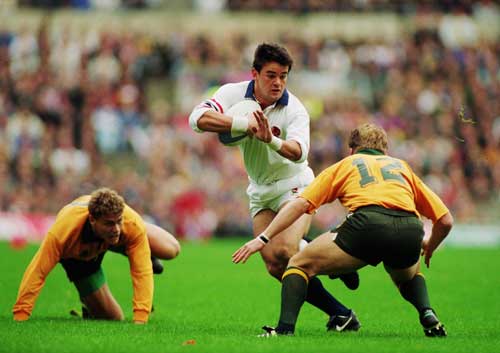
In 1988, at age 22, Lieutenant Will Carling became the youngest ever captain of the English Rugby team. In all he played 72 test, 59 as captain, and lead the side to four Five Nation championships.

He was the unsuccessful captain in the 1991 world cup final at Twickenham.

You won’t find Will Carling in this photo.

Nfj

As a rugby player, he has had quite the celebrity status. At one time the press linked him romantically with Lady Di. Today, 14 years after his retirement, he has 45,000 followers on Twitter. (warne888 has 325,000 followers. Between warne888, willcarling and tlembke we have 370,003 altogether.)

Last Tuesday, these twitter followers were entertained to a blow by blow account of Will’s pursuit of a person who had absconded with an iPad he left behind on a train.

Using the ‘Find My iPhone‘ service in MobileMe, he was able to track the culprit to their apartment block. ‘Find My iPhone‘ is available free online and also as an iPhone or iPad app. It tracks the location of an iPhone and displays it on a google map. (Unfortunately, it can only pinpoint location within a few metres. It is not accurate enough to tell you that the phone is in the back pocket of the pants you wore last week and are now in the bottom of the dirty clothes basket)

WIth ‘Find My iPhone‘ you can send messages to your missing iPhone/iPad, tell it to make noises so you can find it in your home, remote lock it, or remote wipe it (if it is stolen).

The UK’s Daily Telegraph completes the story using Will’s tweets- 

The drama begin after Mr Carling left the portable device on a train on Tuesday.

Using ..’Find My iPhone’.., he narrowed the location of the thief. He then door-knocked 18 doors and left letters appealing for the thief to give back his iPad, but had no success.

“On an adventure! Left my iPad on train yesterday, Doh! Have now tracked it down to a building in Woking. On my way! Could be interesting!,” he tweeted.

“Used the Mobile me tracker. It is in a block of flats! Managed to get in & knock on all 18 doors! No answer surprisingly. So left notes :-O.”

But then the situation took a dramatic turn after he saw that the thief had fled to the local train station, in a situation he described as “like Enemy of the State”, in reference to the Hollywood movie staring Will Smith.

Mr Carling then called police, where he became involved in a “priceless” conversation with the operator, who was clearly a fan.

“The olice (sic) have been notified. So all go in the iPad rescue. Cracking line from the Police lady who was talking to me about old rugby players … priceless :),” he wrote.

He then continued: “Can’t believe this. Mobile me is now showing my iPad near the station round the back of some shops- has it been dumped???”

“Just sent the moving iPad a message telling them they are being tracked! quoted Police crime reference. Shall update soon…..

“The iPad was locked, so they will not know whose it is (unless they have hacked in!) so watching it moving as I type…..”

Mr Carling, who now manages his own management company, later added: “breaking news. iPad is ‘heading’ towards the local Police Station. Feel like a real spy…….

“Just sent the ‘moving’ iPad a message ‘you are very close to the Police Station now….’ would freak you out if you had hold of it….:-).”

To his relief, he then told his followers that he had success. Police had phoned him saying his iPad had been handed in.

It remains unclear if the person who took the iPad was the thief or a good Samaritan who handed it in.

“Result! Police have just called, iPad has been handed over! It was handed into Woking Station. 

Tracked it all on Mobile me – weird / awesome …,” he said.

After turning up at Woking Police station, he was denied a picture with officers but he later posted a photograph of his stolen iPad. He thanked police for their help.

“Rescued iPad! Might check the finger prints on it! Ha ha,” he told his followers.

Mr Carling could not be reached for comment last night. A spokesman for Surrey Police was unavailable for comment. No arrests have been made.


(NB This story could also have been titled ‘iPad left on train – later handed in to police’, but it would have been less dramatic)


What I Learnt On 14th February in other years

14th February 2015 A Valentine’s Day Present
Add a comment
.