delete

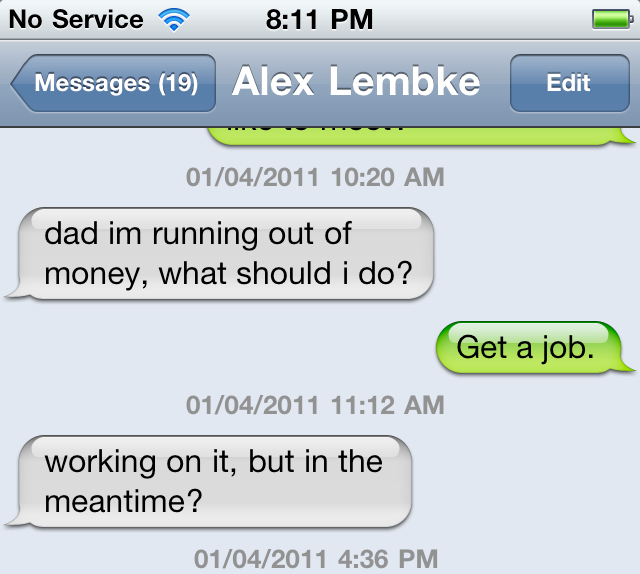
“Dad, have you got any money?”

Do you sometimes feel like a walking ATM?

Alex_text

When I was a fresher at college, I shared ‘goober corridor’ with Mick and Matt. (named after those two, not me, obviously). Mick  found it very convenient to use Matt’s toothpaste, and after a few weeks became very skilled at milking the last little bit out of the tube. As this became harder and harder, he complained bitterly about Goober Matt’s slackness in not buying more.

Little did he know that while the empty ‘Goober toothpaste’ sat prominently on the sink, Matt had a fresh tube hidden behind the textbook “Introduction to Agricultural Science”, where there was no chance Mick would ever look.

Perhaps, in the delivery suite, all new dad’s should be supplied with a special ‘Goober wallet’ that they can demonstrate is empty of cash, and a second real wallet, full of money, that always remains a secret.

Bank_of_dad

Alternatively, they could be supplied with the iPhone App ‘The Bank of Dad’, which makes it simple to keep track of the ‘loans’ we provide to our children. It also has the facility to enter repayments or even deposits in advance, although I think the developers have wasted screen real estate in providing this.

Bank Of Dad - Jebudas Communications, Inc.     Bank of Dad is a free app.Bank Of Dad – App Store Link

Add a comment
delete

Santiago_de_compostela

Life as a pilgrim in Spain is not all cerveza and skittles. Our friend Michelle is embarking on the Camino de Santiago de Campostela tomorrow to find out.

The ‘Way of St James’ is a collection of old pilgrim routes that have the cathedral at Santiago de Compostela in North West Spain as their final destination.

Codex_calixtinus_liber_sancti_jacobi_f0173k

According to legend, St James the apostle travelled to Spain to preach the gospel. When he returned to Jerusalem, he was beheaded by Herod himself. His body was taken back to Spain by angels in a rudderless boat, and buried in Compostella. St James is to Spain, as St Patrick is to Ireland. Santiago is the Spanish word for ‘St James’. Santiago de Campostela ( ‘St James burial place’) is the city that was built around the relics, and is now the capital of Galicia, an ‘autonomous community’ of Spain.

Since the middle ages, the Camino de Santiago de Campostella (‘Way of St James’) has been one of the top three Christian pilrimages, or holy journeys – up there with Jerusalem and Rome. Pilgrims are rewarded with Plenary Indulgences, which are like ‘Get Out of Jail Free’ cards to reduce the time spent in purgatory after death (being married to Brendan, Michelle will have no need for extra plenary indulgences). By visiting sites associated with saints, some of their good deeds are credited to you – you benefit from the ‘Communion of Saints’ and receive a share of their deposit in the Treasury of Merit.

Camino2

The Camino was very popular from about 1000 to the 1500s, but had been in some decline since. If this whole business has slipped under your radar, it would be because in the early 1980s only a handful of pilgrims arrived in Santiago each day (there were 690 pilgrims in 1985). However, since then there has been a resurgence of interest. The route was declared the first European Cultural Route by the Council of Europe in October 1987; it was also named one of UNESCO’s World Heritage Sites. Last year was a Holy Year (when the feast of St James falls on a Sunday) and more than 270,000 made it to Santiago (700 a day!). Some undertake the journey as a religious pilgrimage, some do it for a  good long walk, and ‘many consider the experience a spiritual adventure to remove themselves from the bustle of modern life. It acts as a retreat for many modern “pilgrims”.’ (Wikipedia) At 700 people a day, it may soon be more peaceful to stay at home.

There are a number of different starting points that pilgrims may choose for the Camino. Many of these are in Southern France. The most popular route is the Camino Francés, starting from Saint-Jean-Pied-de-Port. The Northern Route (along the coastline from San Sebastian) and the Portuguese route (approaching Santiago from the South) are also popular.

I_mapa_frances
I_mapa_norte_primitivo


Pilgrims travel with a document called the credencial, or pilgrim’s passport. As an official pilgrim, you can stay iinexpensively in hostels (known as a refugio or albergue). Each day you need to get your credencial stamped in one your albergue or in the local church.

Passport

The alberque are simple shared accomodation. Word on the street is that the two most unpopular fellow pilgrims are ‘bag rustlers’ who think it is a good idea to make a 4:30 am start, and ‘snorers’, who are likely to be the last out at 7am.

Start the day with a walk to the closest bar, to join fellow pilgrims in a coffee.

Then walk, and walk, and walk. Michelle plans to do about 35km each day, on the Northern Route.

Camino-de-santiago-galicia-asturias

Tortilla de patatas – egg and potatoes – on a bagette for lunch, perhaps.

In the evening, every town has a bar which serves the Pilgrim’s menu. Three course with wine for 7- 10 Euro. Soup or salad as entree. Fish or chicken or meat, desert of ice cream or fruit.

Menu

How long it takes depends on were you start, how fast you walk, how long you choose to walk each day, and how long you’ve got. The full Northern Route is 960 km and takes about 6 weeks. Many spend 8-9 weeks on the longer routes. You can, of course, start or stop wherever you like.

When you arrive in Santiago, if your credencial proves that you have travelled at least 100km, you can be awarded a compostela, a certficate of accomplishment. If, unlike Michelle, you are in desperate need for Plenary Indulgences as quickly as possible, you should start from the Spanish city of Sarria, which is just over the 100km mark.

A special mass is held in the Cathedral each day at noon, where the names and countries of origin of pilgrims who have gained a compstella the day before are announced. They also have penance in a number of different languages – I think it would be a good idea to go to the Portuguese speaking priest to confess.

Have fun, Michelle, and let us know how you go.


Some travel sites:


What I Learnt On 21st May in other years

21st May 2020 1986
Add a comment
delete

Louis_xiv_of_france

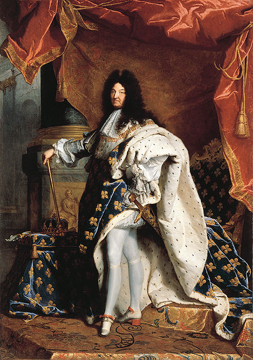
Elizabeth II has been reigning over us for a long time, but it is unlikely she will overtake the world record holder Louis XIV of France. He became king of France in 1643 at the age of 4, and remained monarch till his death (from gangrene) at age 76.

Practice makes perfect.

He was very very good at playing the role of Le Roi Soleil – the Sun King. He had a daily ritual, or ‘lever’, which began with a royal dressing that took 2 hours. He had the kingly-look down pat, and built the grand palace at Versailles to match. When he moved the court to Versailles, he devoted his old place, Le Louvre, to the arts, of which he was a magniicent patron. He became the archetypal royal whose style  the rest did their best to follow – the Lady Gaga of his time.

Chateau-de-versailles-cour

However, where he outdid the other monarchs was that as well as being excellent at playing the part of king, he devoted himself to being good at the real work of leadership – administration and decision making and law making and the other duties that noblesse oblige. With no power sharing magna carta, French kings were significantly more powerful than English ones.He successfully centralised power in Paris, codifed the civil law across France (Code Louis), modernised the army, and developed the French economy with a skilled migration scheme, an improved system of taxation and a focus on export earnngs. This may be how he escaped the beheading that was the fate of many of his foreign contemporaries.

This then is the advice he wrote to his grandson Philip before he assumed the job of king of Spain.

“Never favour those who flatter you the most, but hold rather to those who risk your displeasure for your own good. Never neglect business for pleasure, organise your life so that there is time in it for relaxation and entertainment. Give the business of government your full attention. Inform yourself as much as you can before taking any decision. Make every effort to get to know men of distinction, so that you may call on them when you need them. Be courteous to all, speak hurtfully to no man”

What I Learnt On 20th May in other years

Add a comment
delete

May 19 2011

Waterslides

I’ve always thought this would be a particularly cool way of getting home from work each day.

Oobject.com  have recently posted a collection of 12 of the world’s best waterslides.

Bags having go on the well named ‘Insano’ in Brazil.

Insano

Our own Wet And Wild has some new ‘high thrill’ rides, including the Tornado.

Tornado

If you’d like to feel what it’s like to ride home on the Barclay’s waterslide featured in the video, Millie reckons the Waterslide app for iPhone is good fun.

What I Learnt On 19th May in other years

19th May 2020 Have a Squiz at These
Add a comment
delete

Matt went to a lot of trouble to propose to Ginny.

His arranged for his brother Charlie to take her to the movies as Matt was ‘working.’

And then………..

Full back story at mashable.com


What I Learnt On 18th May in other years

18th May 2012 Why Rugby Has BacksWhy Rugby Has Backs
Add a comment
delete

Netspeak

Should it be “What I Learnt Today?” or “What I Learned Today?”

I am “waiting for” a response, or I am “waiting on” a response?

Netspeak at http://www.netspeak.org is a cool tool that provides a ‘common language’ search. It answers questions about preferred usage, by searching the web for matches for a phrase you specify.

Replace a word you’re not sure about with a ‘?’, or have Netspeak pick between two options using square brackets [ ].

Try these

what I [learnt learned] today

Try it

shows “What I learned today” is much more commonly used than “What I learnt today”
(imagine all those 12,503 people being incorrect, and only 304 being on the money) 

a ? in time

Try It

shows ‘a point in time’ is most commonly used – followed by ‘a moment in time’, ‘a wrinkle in time’ (?) and ‘a stich’ in time

? Lembke

Try It

shows that the most common first name for a Lembke on the web is Holger.

More examples at the Netspeak site

PS. It seems that cousin Holger has his own website. I wonder what it is for? Sprechen sie deutsch?  Unfortunately, my German is completely informed by what I learnt from Hogans Heroes. Achtung! Schnell! I know nufink. At least I can speak to Mike.


What I Learnt On 17th May in other years

Add a comment
delete

Usainbolt2

We all know that people of West African origin are good sprinters because they have more ‘fast twitch’ muscle fibers. Right? And people of East African origin, particularly those from Ethiopia, have muscles that are better for endurance running because of ‘slow twitch muscle fibres’. Correct?

No, wrong – according to Dr Yannis Pitsiladis, who’s Reader in Exercise Physiology at the University of Glasgow. There are no published studies comparing muscle biopsies between different ethic groups that can demonstrate such a difference. Certainly successful sprinters have more fast twitch fibres, and marathon runners have slow twitch, but this is not based on ethnicity.

“Our students would often ask us in class why is it that no white man up until last year has run 100 metres in under 10 seconds while there have been hundreds of individuals of black colour who’ve managed to do that? Why?” asked Dr Pitsiladis on a recent Health Report.

Of course, genes play an important part in determining athletic potential. If you want to be an athelete, it is better to have athletic parents. But this is independent of ethnicity.  Interestingly, in all the studies of the human genome, they have not determined the difference in genes that make someone look black and someone else look white. (nor tall, for that matter)

So what are the other important factors

Run lots when you are a kid. In Dr Pitsiladis’s studies, many of the kids in Ethiopia ran 5km to their primary schools, home at lunch, back to school and then ran home again at the end of the day. 20km a day! Ethiopians consider running a gift from God. If our kids have to walk a mile it is a Federal Case.

Run without shoes from a young age. Running bare feet, we land on our toes (it hurts too much to heel strike). This has greater shock absorber effect, reduces injuries and prepares us for a lifetime of running and for the hard training required to make it as an elite athelete. By the time we a adolescents, it is too late to change to bare feet running.

Have a hunger to do well. Many young people have to do well at sport or return to poverty. That is a strong motivator.

Too late for me, I’m afraid, but the shoes are coming off Millie tomorrow. A 5km barefoot jog to school each morning should be just the ticket.

You can listen to or read the interview between Norman Swan and Yannis Pitsiladis at the Health Report site.


What I Learnt On 16th May in other years

16th May 2020 La tour de lockdown
Add a comment
delete

025_cb_sp_high_five

Performing a coordinated High Five requires quite a knack.
Cool when done well, it can be a common cause of an ‘epic fail’.


NASA crashed a bomb into the moon – which you’d have to agree is a good shot. However, the red-shirted scientist in this live feed got ‘dissed’ when he tried to initiate a celebratory high five.


Even the usually very cool John Mayer can fail


This bear can’t take a trick


Luckilly, not all are as disastrous as this one


For a coordinated sportsman, this is a sad miss.

(Lucky the crowd was so small)


So what is the secret to a perfect high five.

Will tells me that the secret to never missing a high five is for each person to watch the other’s elbow.


This is confirmed by the team at Perfect High Five.


High Five!

What I Learnt On 15th May in other years

Add a comment
.

Subscribe To WILT

Sign up to our mailing list and receive a once daily dose of What I Learnt Today in your email inbox.

This is the best way to keep up with WILT.

Cheers,

Tony Lembke

You have successfully subscribed to WILT. Thanks.